
The Perfect Reset Is Wearing Thin
For years, CleanTok promised that even the messiest parts of daily life could be neatly contained. A drawer could be divided into perfect little compartments. A Sunday reset could turn a chaotic home into something polished, scented and colour-coded in an hour.
But that fantasy is starting to wear thin.
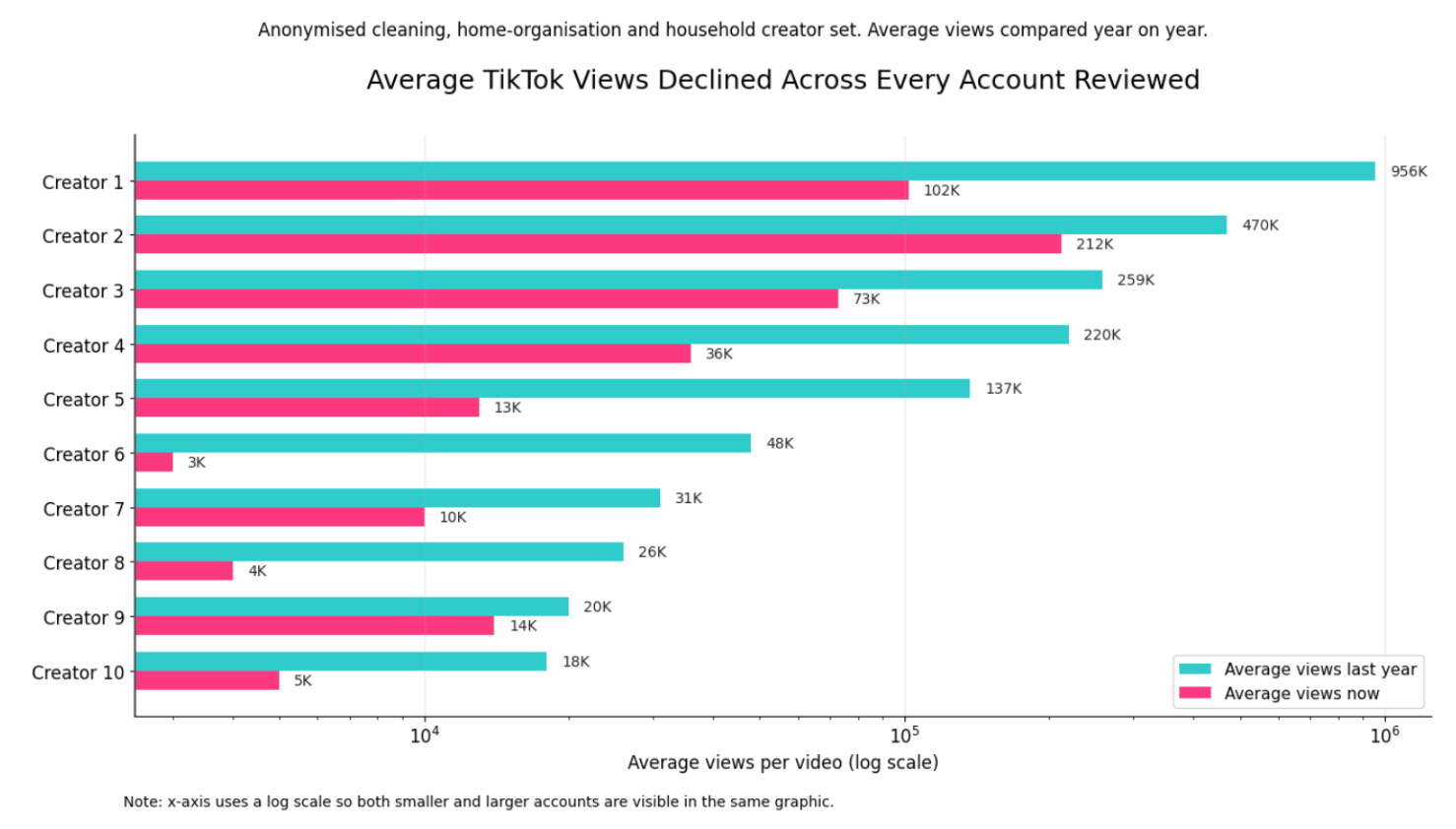
We analysed TikTok cleaning, home-organisation and household creators with followings ranging from 77K to over 3M. Every account reviewed showed a year-on-year decline in average views.
The drops were not marginal.
Across the accounts analysed, the smallest decline was around 29%. The steepest was more than 90%. Most creators sat somewhere in the middle, with average views falling between 50% and 90%.
This suggests the issue is bigger than one creator, one posting schedule or one missed trend. It points to a wider softening of the CleanTok category.
CleanTok Isn’t Dead, But the Old Formula Is Tired
Cleaning content will always have a place online because it is useful, satisfying and relatable. But the old version of CleanTok, the hyper-polished, product-heavy, version, is losing some of its cultural pull.
A September video from @christyycleantok captures this perfectly: matching pink products, pink gloves, pink bin liners and a separate cleaner for almost every surface. The fast-paced edit makes a full top-to-bottom bathroom clean look effortless, making what is usually a time-consuming chore something neat, aesthetic and easily achievable.
Part of the problem may be repetition. The format became highly recognisable: the messy room, the miracle product, the speed-clean montage, the sparkling reveal. What once felt soothing started to feel staged.
But this is not necessarily a simple story of audiences losing interest. Some creators may still be holding attention on platforms like Instagram, suggesting the decline could also be shaped by TikTok’s algorithm, category saturation and changing discovery patterns.
The issue is likely a mix of things: familiar formats, less novelty, more competition and growing scepticism around product-heavy routines. Audiences have seen the same fridge restock, mop bucket, cupboard reset and “life-changing” product too many times. The content still works, but the old formula no longer cuts through as reliably.
The Consumerist Side Is Losing Appeal
There is also growing discomfort with the kind of consumerism that powered much of the category. TikTok has not become anti-shopping. Product-led content still performs when it feels entertaining, surprising or tied to personal taste. But CleanTok’s consumerism often came packaged as self-improvement: the idea that a better home required another spray, another gadget, another organiser or another viral tool.
That feels less persuasive in the current mood. As conversations around overconsumption, deinfluencing and using what you already own become more visible, product-heavy cleaning routines can start to feel excessive rather than aspirational. The issue is not that audiences no longer like buying things. It is that they are more likely to question content that makes constant buying feel necessary for maintaining a clean, organised home.
What Now?
That worked when audiences were still excited by endless optimisation. But the mood has shifted. Viewers are becoming more sceptical of constant product recommendations and more interested in making better use of what they already have. This does not mean the appetite for satisfying home transformation has disappeared. Recent furniture-flipping content fulfils a similar niche to CleanTok, offering the same clear before-and-after payoff without relying on a cupboard full of new products.
A June post from Logan Lists, showing an old television being turned from “junk” into a statement piece, had reached 1.7M views and 147K likes, suggesting that audiences are still drawn to transformation when it feels creative, affordable and resourceful. The home is no longer just a place to optimise. It is a place people are trying to maintain realistically, without being told they need to buy something new every week.
The Environmental Cost Is Harder to Ignore
There is an environmental tension here too. At its most extreme, CleanTok encouraged a kind of over-cleaning culture: cupboards full of single-use wipes, plastic bottles, scented sprays, disinfectants and specialist products for every possible surface. The result was visually satisfying, but also product-heavy, chemical-heavy and wasteful.
That feels increasingly out of step with the way people are thinking about their homes. Audiences are more aware of what they bring into their living spaces, what those products leave behind and how much waste is created by constant repurchasing. A “clean” home no longer needs to mean harsh chemicals, artificial fragrance and a cupboard full of plastic bottles.
This is helping fuel interest in a softer, more sustainable version of home care. Instead of harsh-product hauls, viewers are gravitating toward simpler routines, refillable products, lower-tox cleaning, reusable cloths, organic ingredients and solutions that feel safer for children, pets and the planet.
Julia Bouvier offers a useful example. Around this time last year, one of her stronger posts was about a $15 cap, which reached 10.1K views. Since shifting her content style and topic toward non-toxic, natural and plastic-free habits in the apartment, her content appears to have grown significantly: a recent post in this style reached 12.7M views and 2.1M likes.
The comparison suggests that audiences are responding strongly to lifestyle content that feels domestic, practical and lower-consumption. The appeal is not just sustainability in the abstract. It is a different version of clean: fewer harsh products, less plastic and a home that feels safer, simpler and easier to live in.
The shift is not only ethical. It is sensory. The new version of clean feels less like bleach, shine and perfection, and more like fresh air, natural textures, calmer homes and routines that are easier to live with.
The Least Affected Accounts Show the Way Forward
The accounts with the smallest declines offer the clearest clues about where the category is moving next.
The accounts with the smallest declines offer the clearest clues about where the category is moving next. Andrea Vowels saw the smallest drop in the dataset, with average views down 29%, while Elnaz Hamai, Lynsey Queen of Clean, and The Sister Shoppers were also less affected than the steepest-declining accounts.
They were not simply repeating the classic CleanTok formula more efficiently. Instead, they gave viewers a clearer reason to watch: practical household fixes, sensory cleaning moments, seasonal ideas, realistic routines, broader home content and product discoveries that felt genuinely useful rather than purely promotional. The pattern suggests that cleaning and organising content can still perform when it moves beyond the generic reset and gives audiences something more specific to take away.
In other words, the strongest content was less about the perfect transformation and more about the payoff. It solved a small problem. It created a calming moment. It showed a clever shortcut. It made an everyday task feel easier, cheaper or more satisfying.
This suggests audiences are not rejecting cleaning content entirely. They are rejecting cleaning content that feels interchangeable.
The Next Era Is Smaller, Smarter and More Real
CleanTok’s old promise was simple: buy this, clean this, organise this, and your life will feel together.
The new promise is quieter and probably more durable: here is one small thing that might make your real life easier.
That may not be as glossy. It may not always look as good in a thumbnail. But it is where the audience is going.


