
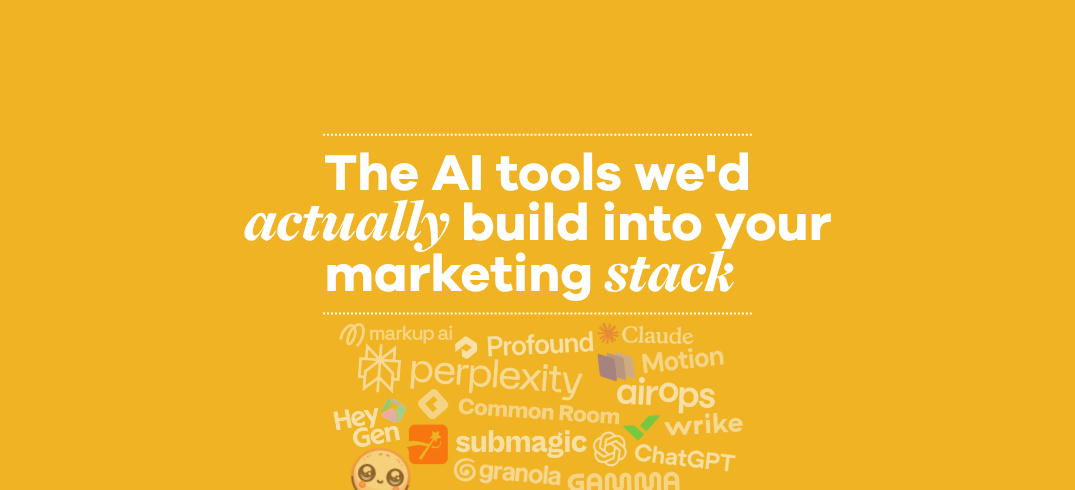
This isn’t a top 10, a countdown, or a best-of roundup. It’s the shortlist of AI tools we’d genuinely put in front of a marketing team, organised by the job each one solves, with our reasoning for each. No sponsorship involved. Just the tools we rate.
AI search visibility: Profound
Google used to be the whole game. Now people are asking ChatGPT, Perplexity and Gemini to make the recommendation for them. If your brand never gets a mention in that answer, ranking well on a results page barely matters.
Profound closes that visibility gap. It tracks whether AI models are citing your brand, ignoring it, or recommending a competitor instead.
Hot take: give it two or three years and every brand will have something like this in the stack. Right now, most are still treating it as optional. That gap is the opportunity.
SEO and on-page optimisation: Surfer SEO
AI visibility tools like Profound cover the new frontier, but traditional search hasn’t gone anywhere. Most B2B buying journeys still start with a Google query. Surfer SEO closes the gap between “we published a blog post” and “that blog post actually ranks,” by benchmarking content against what’s already working for a given search term and flagging the structural gaps before it goes live.
Hot take: teams keep treating “rank on Google” and “get cited by AI” as two separate projects. They’re not. It’s the same content doing two jobs, and Surfer’s one of the few tools built for that.
GTM intelligence: Common Room
Every go-to-market (GTM) team wants the same thing: real signs that someone’s ready to buy, not just a list of accounts that look right on paper.
Common Room finds that signal in the places it actually shows up: community activity, product usage, the digital footprints that used to need a full-time analyst to catch, all before a lead ever fills out a form.
Hot take: most GTM stacks were built for a world where intent shows up as a form fill. We don’t live in that world any more, and the teams still waiting on the form fill are the ones falling behind.
Meeting and customer intelligence: Granola
Common Room watches the digital signals. But there’s another category of intelligence most teams still let evaporate: what’s actually said out loud in meetings.
Marketers spend a lot of time in calls they never fully use: customer interviews, sales debriefs, exec syncs. Most of that context is gone the moment the call ends. Granola sits quietly in the background and turns it into a clean, structured set of notes, without anyone taking manual notes on the call.
Hot take: some of the best positioning lines we’ve ever landed on came from something a client said off-hand in a meeting, not from a brand document. Most of that gets lost. This is the tool that stops it disappearing.
Presentations and strategy docs: Gamma
Every marketer has lost an afternoon formatting a deck nobody looks at twice. There’s a reason “good at decks” and “good at marketing” often feel like two different jobs.
Gamma turns a messy outline into a polished deck, one-pager or strategy doc in minutes. The point isn’t making things shinier. It’s getting the formatting out of the way so your team can spend time on the actual thinking.
Hot take: nobody’s ever won a pitch because the deck had nice padding on every slide. They win because the idea was clear. Gamma just gets the file out of the way of the idea.
Content operations: AirOps
Content used to run on one person, one doc and a deadline. At the volume marketing teams operate at now, that’s a system problem, not a writing problem.
AirOps is built for teams producing content at a scale that would have sounded absurd three years ago: SEO pages, programmatic content, briefs generated in minutes instead of hours. It’s not “write this for us.” It’s “build the pipeline so the team stops doing the same manual work every week.”
Hot take: content volume stopped being the differentiator years ago. Consistency at volume is the actual skill now, and that’s a systems problem, not a talent one.
Creative: Motion, HeyGen and Submagic
Creative is where marketers are most sceptical of AI, and fair enough too. Nobody wants a brand that sounds synthetic.
Motion isn’t about generating creative out of thin air. It’s about testing more variations, faster, with real performance data behind the decision instead of a gut call.
HeyGen solves a quieter problem: localisation. Turning one video into ten languages used to mean ten shoots and ten budgets. Now it’s one input, with an AI avatar doing the heavy lifting.
Submagic is one our own team trusts and use daily for our clients. It auto-generates captions that hold attention, but the real time saved is everything around them: turning one long video into multiple shorts, dropping in B-roll, cutting dead air, all without opening a traditional editing timeline.
Hot take: the marketers being precious about “the one perfect ad” are going to lose to the ones running fifty imperfect ones and letting the data pick a winner.
Marketing operations: Wrike
Every team has that one workflow: seventeen steps, spread across five tools, understood by exactly one person.
Wrike is where that mess gets tidied up, especially once you’re running enterprise-scale marketing ops with multiple approval chains and campaigns moving at once. It’s not the flashiest tool on this list, but it’s the one holding everything else together.
Hot take: most marketing chaos isn’t actually a strategy problem. It’s an ops problem wearing a strategy costume. Fix the ops and half the “we need a rebrand” conversations disappear on their own.
Long-form writing: Claude
Most AI prompt libraries are full of first drafts that read exactly like first drafts. Fine for a quick caption. Not fine for a thought-leadership piece with your CEO’s name on it.
Claude is what we reach for when the writing has to actually hold up: long-form pieces, positioning documents, anything that needs to sound like someone who’s thought it through, not a model making its best guess. It’s the difference between content that reads as AI-assisted and content nobody would ever flag as AI-assisted.
Hot take: the “AI writing sounds robotic” problem was never really about the AI. It was about people skipping the editing pass. Claude just makes that pass shorter.
Creative review and approvals: Markup.ai
The hardest part of any campaign was never making the creative. It’s the rounds of Slack messages and “can we nudge the logo two pixels” comments that follow it.
Markup.ai centralises creative feedback and sign-off so approvals stop dying in someone’s inbox. It won’t win any awards for excitement, but ask any marketer how many hours a month disappear into approval chaos and it’s obvious why this makes the list.
Hot take: approvals are the most expensive line item nobody puts in a budget. Track the hours honestly and a tool like this pays for itself inside one campaign.
Research and strategy: ChatGPT and Perplexity
ChatGPT is the obvious pick, and that’s fine. Obvious doesn’t mean wrong.
It’s become the default thinking environment for a lot of marketers, not just for drafting, but for stress-testing positioning, structuring campaigns, and acting as a sparring partner you don’t need to book a meeting with. If your team doesn’t have a shared prompt library yet, that’s the actual gap, not the tool itself.
Perplexity earns its place doing what ChatGPT still isn’t built for: fast, sourced competitive research. Need to know what five competitors are saying about a category shift, with citations, in under two minutes? That’s Perplexity’s job. Skip that step and default to guesswork instead, and don’t be surprised when a competitor lands the same idea first.
Hot take: teams still treating ChatGPT as a fancy autocomplete are leaving most of its value on the table. It’s a strategy tool that happens to write, not a writing tool that happens to strategise.
Research synthesis: Poppy AI
Perplexity gets you an answer fast. What it doesn’t solve is everything that piles up after: the YouTube videos you meant to watch, the podcast clip you wanted to quote, the voice memo from the car that never got listened to again.
Poppy AI is a visual, whiteboard-style workspace. Drop in videos, podcasts, PDFs, voice notes and images, then work across all of it in one place, instead of switching between five browser tabs and a Notion page nobody’s opened in months.
Hot take: research rarely fails because nobody looked for the answer. It fails because the answer’s sitting in nineteen unopened tabs nobody goes back to.
None of this is about chasing every new tool that lands in your inbox. It’s about being honest with yourself about where the actual bottlenecks sit in your team, then picking the tool built for that exact job. If you want a hand mapping your own stack against your workflow, that’s a conversation we’re always up for.


